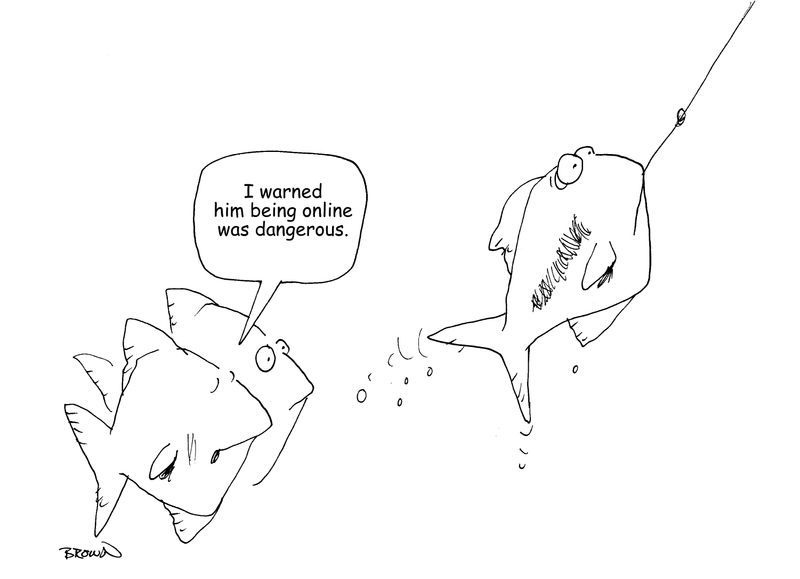
I turned on my VPN and “pettt”, I ended up here!
Tag: CyberSecurity
-
Your Vendor’s Breach Is Your Breach
It’s a Paper Trail for the week ending in May 2, 2026, and we’ll cover what happened last week in the Information Security space.
The Bottom Line
AI is fundamentally changing the speed of cyberattacks. The window between a vulnerability being discovered and it being weaponized is now measured in hours, not days. Simultaneously, the security teams are underpaid, understaffed, and leaving. These two forces together represent a material shift in organizational risk that requires attention, not just a patch cycle.
Last Week, in Review
- Fortinet released its 2026 Global Threat Landscape Report drawing on telemetry from millions of sensors deployed worldwide. The headline numbers are stark: ransomware victims surged 389% year-over-year. More significant for every organization than that count, however, is what’s happening to timing. As AI accelerates reconnaissance, weaponization, and execution, FortiGuard Intelligence shows time-to-exploit has dropped to 24–48 hours for critical outbreaks, a sharp increase from earlier reports that showed a time-to-exploit of 4.76 days. [Fortinet]
- Google announced a significant restructuring of its Vulnerability Reward Programs for Chrome and Android as AI starts to get introduced in the vulnerability research pipeline. Google is now prioritizing flaw categories that are more difficult for AI tools to find, while reducing some lower-tier Chrome awards. For organizations running their own bug bounty programs, the future may hold a higher number of AI-generated low-quality submissions which will swamp triage capacity unless programs are redesigned around it. [SecurityWeek]
- A Harvey Nash Global Tech Talent & Salary Report, based on a survey of over 3,600 technology professionals across 53 countries, found that cybersecurity staff are among the most financially overlooked workers in tech. Globally, 71% of security professionals received no salary increase in 2025. Only 40% of security staff expect a pay rise in 2026. Almost half (49%) are actively looking to move jobs in the next twelve months, well above the global average of 39% across all tech roles. [The Register, InfoSecurity Magazine]
Pulse
LayerX disclosed a high-severity vulnerability (CVSS 8.2) in Cursor – one of the most widely used AI-powered code editors for developers – that allows installed extensions to access sensitive credentials, exposing API keys and session tokens without any user interaction. The issue stems from how Cursor stores secrets locally in plaintext in a local SQLite database, leaving them accessible to any extension regardless of permissions. Cursor enforces no OS-level protected storage or access control boundary between installed extensions and this database. Cursor was notified in February, responded that extensions are within the user’s trust boundary, and as of April 28 had not issued a fix. [LayerX, InfoSecurity]
Vimeo published a security notice confirming that an unauthorized actor accessed customer and user data – not by breaking into Vimeo itself, but by compromising Anodot, a third-party analytics platform Vimeo uses. Exposed data primarily includes technical data, video titles, metadata, and in some cases customer email addresses; video content, login credentials, and payment data were not accessed. This is the third-party risk story in its purest form that highlights that a vendor’s security posture is part of an organizations’ attack surface. [Vimeo, Bleeping Computer, SecurityWeek]
Fix-it Frank
A CRLF injection in cPanel’s pre-authentication session handling allows an unauthenticated remote adversary to inject arbitrary values directly into a session file written to disk before any credential check occurs. This allows adversaries to receive a fully authenticated root WHM session, bypassing both the password gate and two-factor authentication with no requirement for valid credentials. The flaw affects all supported versions of cPanel & WHM after v11.40 and WP Squared prior to v136.1.7, spanning an estimated 650,000+ internet-exposed instances. Confirm with the hosting provider or sysadmin that cPanel is patched to a fixed version, then audit WHM session logs and server-side accounts for unauthorized root-level changes going back to February 23, 2026. [cPanel, Rapid7, watchTowr Labs, Help Net Security]
The Jenkins project – one of the most widely deployed CI/CD platforms – published a security advisory addressing seven plugin vulnerabilities across multiple widely-deployed Jenkins plugins, including high-severity path traversal flaws and stored cross-site scripting (XSS) vulnerabilities. Organizations should review and update all flagged plugins immediately via the Jenkins Plugin Manager. Additionally, Jenkins UI access should be limited to internal networks or VPN and the Jenkins controller should not be directly accessible from the internet under any circumstances. [Jenkins Project]
—
Paper Trail is a weekly briefing, not professional advice. Consult qualified professionals before acting on anything we report.
—
Thanks for tuning-in to this edition of Paper Trail. You can read it, hear it, or bookmark it – find every format at hackwithheart.com.
-

All the Bells and Whistles – None of the Data Protection
Do you have anything to prevent identity theft?
-
The Changing Security Perimeter
It’s a Paper Trail for the week ending in April 26, 2026, and we’ll cover what happened last week in the Information Security space.
The Bottom Line
The perimeter that organizations think they’re defending is no longer where the attacks are coming in. Three converging themes defined the week: a coordinated wave of supply chain attacks targeting tools companies trust by default; AI compressing the window between a vulnerability appearing and an adversary weaponizing it; and early signs that AI is shifting the asymmetry toward defenders – giving security teams an optimistic outlook. Taken together, these are not IT problems but rather business continuity and governance problems.
Last Week, in Review
- A high-severity flaw in LMDeploy – an open-source toolkit used by AI developers to compress, deploy, and serve large language models – was under active exploitation in the wild fewer than 13 hours after its existence was publicly disclosed. [The Hacker News]
- Mozilla published a blog post announcing the release of Firefox 150 that included patches for 271 security vulnerabilities – every one of them identified by an early version of Anthropic’s Claude Mythos AI model during internal testing. While the Firefox team remediated the findings, the Firefox CTO came to an optimistic conclusion that defenders finally have a chance to win, decisively. [Mozilla, SecurityWeek, TechRepublic]
- Cisco Talos published its Q1 2026 incident response trends report that noted that 18% of the engagements in the quarter involved organizations with insufficient logging capabilities, affecting the investigation capability. [Cisco Talos]
Pulse
Vercel – the cloud platform behind the Next.js framework used by tens of thousands of startups and engineering teams – disclosed a breach on April 20 after adversaries accessed its internal Google Workspace environment. The entry point was a third-party AI productivity tool called Context.ai, which a Vercel employee had signed up for using their corporate account and granted “Allow All” OAuth permissions. Context.ai had separately suffered a breach of its own AWS environment, and the compromised OAuth tokens from that incident gave adversaries a bridge straight into Vercel’s Google Workspace. Adversaries claimed to have stolen source code, API keys, environment variable credentials, and internal deployment data. Vercel confirmed the incident and, after working with Microsoft, GitHub, npm, and Socket, stated that its npm packages were not compromised. [Vercel, ContextAI, The Hacker News, SecurityWeek]
Forcepoint X-Labs found 10 distinct indirect prompt injection (IPI) payloads active in the wild – malicious instructions hidden inside publicly accessible web content that silently execute when an AI agent reads or processes that page. Unlike traditional attacks that require a human to interact with malicious content, IPI payloads are invisible to the human user: they sit in HTML comments, metadata fields, or body text and automatically coerce AI agents into carrying out adversary instructions as a direct consequence of agents doing their jobs. Such attacks may affect agents that browse web pages, index content for RAG pipelines, process HTML metadata, and take autonomous actions – making them a high-impact target. [Forcepoint, InfoSecurity]
Fix-it Frank
A supply chain attack compromised @bitwarden/cli v2026.4.0 via a hijacked GitHub Action, which allowed exfiltration of cloud credentials, CI/CD secrets, SSH keys, and AI API tokens to adversary-controlled infrastructure where bitwarden cli was in use. While Bitwarden’s vault and browser extensions were unaffected, the ~1.5-hour exposure window carried significant blast radius given ~250,000 monthly downloads and the package’s prevalent use in secrets-injection pipelines – a single compromised developer machine can propagate access laterally across every pipeline those credentials can reach. Any environment in which the Bitwarden npm package was updated to the affected version should treat credentials on impacted machines as compromised; all exposed credentials should be rotated, GitHub workflows audited for unauthorized changes, and affected systems upgraded to @bitwarden/cli@2026.4.1 or later with the version explicitly pinned. [BitWarden, The Hacker News, SecurityWeek, Socket, Endor Labs]
Three coordinated supply chain attacks across npm, PyPI, and Docker Hub coincided with the Bitwarden incident, with AI API keys, MCP configuration files, and LLM provider tokens explicitly targeted alongside conventional cloud credentials. A self-propagating credential worm in pgserve (npm) autonomously re-injected and republished its payload across both npm and PyPI ecosystems; xinference on PyPI and Checkmarx’s KICS Docker images and VS Code extensions carried identical credential-stealing payloads the following day — the latter serving as a direct vector into the Bitwarden CLI compromise. Any environment that installed these packages during that window should treat all credentials as compromised and rotate immediately; the known C2 endpoint should be blocked at the proxy or DNS layer, and version pinning should be enforced across all CI/CD dependency installs. [GitGuardian, The Hacker News, The Register]
Oracle’s Q2 2026 Critical Patch Update delivers 481 patches across 241 CVEs and 28 product families, with the most acute exposure being CVE-2025-15467 – an unauthenticated remote code execution flaw in MySQL Enterprise Backup affecting versions 8.0.0-8.0.45, 8.4.0-8.4.8, and 9.0.0-9.6.0. Oracle Communications received 139 patches including 93 for remotely unauthenticated vulnerabilities, and 8 of 12 Java SE patches are remotely exploitable. [Oracle, Qualys, SecurityWeek, Tenable]
The Fine Print
CISA had announced a series of virtual town halls organized by sector to gather additional input before finalizing CIRCIA – the law that will require an estimated 316,000 entities across 16 critical infrastructure sectors to report significant cyber incidents to CISA within 72 hours, and ransomware payments within 24 hours. Those town halls, originally scheduled March 9 through April 2, were postponed. [CISA]
—
Paper Trail is a weekly briefing, not professional advice. Consult qualified professionals before acting on anything we report.
—
Thanks for tuning-in to this edition of Paper Trail. You can read it, hear it, or bookmark it – find every format at hackwithheart.com.
-
The End of Enrichment: NIST Pivots as Vulnerability Volume Soars
It’s a Paper Trail for the week ending in April 18, 2026, and we’ll cover what happened last week in the Information Security space.
The Bottom Line
The federal agency – NIST – stopped fully vetting many software vulnerabilities this week, eliminating a key resource companies have long relied on to prioritize where to focus security resources – at precisely the moment adversaries are exploiting newly disclosed weaknesses in hours, not weeks. Meanwhile, the AI tools developers use to write and review code were shown to be weaponizable, and a children’s privacy law – COPPA – with penalties exceeding $53,000 per day per violation hits its compliance deadline in three days.
Last Week, in Review
- CVE submissions to the National Institute of Standards and Technology (NIST) for National Vulnerability Database (NVD) – the world’s primary public catalogue of software vulnerabilities – have grown 263% between 2020 and 2025, with Q1 2026 tracking nearly one-third higher still. While NIST tries to fully analyse and score (“enrich”) reported vulnerabilities by adding additional context and information, NIST could not clear its enrichment backlog for vulnerabilities in 2025 due to the unprecedented scale of reports. Due to this, on April 15, NIST announced it is fundamentally shifting how it operates NVD. Effective immediately, NIST will only enrich a subset of newly reported vulnerabilities: those actively exploited by adversaries, those affecting federal government software, and those in critical infrastructure software. All others will be listed but left unenriched and will lack independently validated severity scores and affected product data. [NIST, Reed Exhibitions, The Record]
- On April 14, Microsoft released security updates addressing 160+ vulnerabilities – the largest single Patch Tuesday release of 2026. The release included a patch for an actively exploited SharePoint Server zero-day (CVE-2026-32201), a spoofing flaw that allows an unauthenticated adversary to access and potentially alter sensitive information over a network. Another notable vulnerability that also got patched includes a Windows Defender vulnerability dubbed “BlueHammer” that grants an adversary full SYSTEM privileges. Separately, Google patched Chrome’s fourth actively-exploited zero-day of 2026. [CrowdStrike, SecurityWeek, Krebs on Security, SecurityAffairs]
- Sysdig released its 2026 Cloud-Native Security and Usage Report based on analysis of billions of software packages across hundreds of thousands of cloud identities. The report found that human identities now account for just 2.8% of all identities in cloud environments; the rest are automated systems, AI agents, service accounts, and machine credentials. Furthermore, the report noted that adversaries are now exploiting some vulnerabilities within hours of public disclosure – collapsing the window defenders have to patch before active exploitation begins. The report concludes that organizations have reached limits of human-driven security operations and must shift to machine-speed detection and automated response. [Sysdig]
Pulse
Security researcher Aonan Guan with Johns Hopkins University researchers Zhengyu Liu and Gavin Zhong, revealed a prompt injection technique named “Comment and Control” that hijacks three major AI coding agents – Anthropic’s Claude Code Security Review, Google’s Gemini CLI Action, and GitHub Copilot Agent – on GitHub using a single attack pattern. By embedding malicious instructions in ordinary GitHub pull request titles, issue bodies, or comments, an adversary can trick the AI agent into extracting API keys and access tokens and posting them back through GitHub itself. [Aonan Guan, SecurityWeek, The Register]
A new malware kit called Venom Stealer, confirmed this week, lets any operator run polished phishing campaigns with no technical skill for as little as $250/month. Separately, Rapid7’s managed detection team caught an active campaign impersonating a Claude AI installer targeting employees in both the EU and US. The attack bypasses email and endpoint controls because the victim executes the payload themselves, believing they’re installing legitimate software. [Rapid7, KnowBe4]
Elastic Security Labs published a new campaign – REF6598 – where adversaries pose as venture capital partners on LinkedIn, build credibility over Telegram with populated group chats, then invite targets to open a shared workspace tool that silently installs a sophisticated remote access trojan. The attack uses the functionality of a legitimate note-taking application (Obsidian) to execute malware – making it harder to detect/block using standard endpoint controls. Furthermore, the malware uses blockchain networks for command infrastructure, making it difficult to shut down by blocking domains. [Elastic]
Fix-it Frank
Adobe released an emergency out-of-band update addressing a prototype pollution vulnerability in Acrobat Reader (CVE-2026-34621) that allows arbitrary JavaScript execution – and therefore arbitrary code execution – when a specially crafted PDF is opened, including through the Windows Preview Pane without a user double-click. CISA added it to the Known Exploited Vulnerabilities catalog on April 13 after confirming in-the-wild exploitation going back to at least November 2025. Adobe revised the CVSS attack vector from Network to Local on April 12 (adjusting the score from 9.6 to 8.6), though phishing delivery of a malicious PDF remains a realistic and well-documented initial-access path. Update Adobe Acrobat Reader and Acrobat DC to version 26.001.21411 or later. [Adobe Security Bulletin APSB26-43, The Hacker News]
Horizon3 researcher Naveen Sunkavally discovered a code injection flaw in Apache ActiveMQ – a popular message broker in financial services, healthcare, e-commerce, and microservices middleware stacks. An adversary with access to the Jolokia JMX-HTTP management API can invoke the operation with a crafted URI, causing the broker to fetch a remote Spring XML configuration and execute arbitrary OS commands on the broker’s JVM. The vulnerability requires authentication, but many deployments use default credentials – limiting the benefits of authentication. Upgrade to Apache ActiveMQ Classic version 5.19.4 or 6.2.3. If immediate patching is not possible then restrict network access to the ActiveMQ web console (port 8161) via firewall; disable or restrict the Jolokia endpoint; change all credentials away from the default. [Horizon3.ai, Apache Advisory, The Register]
Two command injection vulnerabilities in PHP Composer’s Perforce VCS driver allow an adversary to execute arbitrary OS commands on a developer’s machine during composer install or update command runs. The higher-severity flaw (CVE-2026-40261, CVSS 8.8) is exploitable through malicious package metadata served by any compromised or adversary-controlled Composer repository as Composer processes the malicious source reference and passes it to a shell command without escaping, executing the injection. Update Composer to 2.9.6 (mainline) or 2.2.27 (LTS branch). [GitHub Advisory, GitHub Advisory, The Hacker News, Packagist / Composer Advisory]
The Fine Print
FTC’s updated COPPA – for any business operating websites, apps, or online services directed at or knowingly collecting data from children under 13 – rules bring four key new obligations: biometric identifiers (facial geometry, voice prints, etc.) are now classified as personal information, separate verifiable parental consent is required for any third-party data disclosures not integral to the core service, and operators must have a written Information Security Program (WISP) and a documented data retention/deletion policy in place. With a full compliance deadline of April 22, 2026, non-compliant operators may face FTC enforcement action with per-violation penalties now exceeding $53,000 per day. [ComplianceHub.Wiki]
—
Paper Trail is a weekly briefing, not professional advice. Consult qualified professionals before acting on anything we report.
—
Thanks for tuning-in to this edition of Paper Trail. You can read it, hear it, or bookmark it – find every format at hackwithheart.com.
-
Shifting Dwell Times, Weaponized Polyglots, and AI Privacy Laws
It’s a Paper Trail for the week ending in March 28, 2026, and we’ll cover what happened last week in the Information Security space.
Last Week, in Review
- Google’s Mandiant M-Trends 2026 report – based on 500,000+ hours of incident response in 2025 – identified that hand-off time between initial access brokers and follow-on adversaries has collapsed to a median of 22 seconds from 8+ hours in 2022, with global median dwell time rising from 11 days to 14 days. Furthermore, ransomware attacks are not only leading to an organization’s data being encrypted but also to destruction of backups, identity services and virtualization management planes to deny recovery. [Google]
- The introduction of Semgrep Multimodal and GitHub’s AI-powered bug detection alongside CodeQL points to a growing consensus that pure static analysis and pure AI based security code scanning fall short on their own. As AI supercharges both code output and exploit development, the industry is converging on the defense of merging them together to help keep pace with deterministic precision, and amplified machine reasoning. [GitHub, Semgrep]
Pulse
Deepfake technology is now cheap but realistic enough that adversaries can use AI-cloned voices and video to impersonate executives and authorize fraudulent wire transfers – creating a possibility of incidents going unreported because employees believe that they are talking to real colleagues. No U.S. law requires companies to disclose a successful deepfake attack, leaving a significant regulatory blind spot as the threat scales. Organizations should combine simulated deepfake drills, AI detection capability, and – most critically – mandatory out-of-band verification for any digital request involving payments or system access. [Bloomberg Law]
A sophisticated multi-stage, multi-ecosystem supply chain compromise was used to gain a foothold and compromise LiteLLM – a package used by AI frameworks relied upon by Stripe, Netflix, Google, and thousands of startups – and found in 36% of all cloud environments according to Wiz, meaning any developer or pipeline that installed the package unknowingly pulled down credential-stealing malware alongside it. The attack is notable not just for its scale, but its method where adversaries first compromised Aqua Security’s Trivy – a widely trusted security scanning tool – to gain a foothold in the software supply chain, then used that position to push malicious code into LiteLLM on PyPI. Since malware arrived through a trusted and routine update, developers and automated pipelines had no reason to suspect it. Organizations should audit any Python environments, CI/CD pipelines, or containers that installed LiteLLM between 10:39 – 16:00 UTC on March 24 for compromised versions 1.82.7 and 1.82.8 of LiteLLM. If these versions are found, all secrets from affected systems should be rotated. [DataDog, Snyk, The Record]
Fix-it Frank
Insufficient input validation leading to memory overread vulnerability (CVE-2026-3055) in Citrix NetScaler ADC and NetScaler Gateway versions prior to 13.1-62.23 for 13.x series or 14.1-66.59 for 14.x series are under active reconnaissance and – if exploited – could allow an adversary to read sensitive contents from the memory. It is recommended to upgrade these appliances to the latest and supported versions to remediate vulnerabilities. [Citrix, watchTowr Labs, The Hacker News]
Apple issues emergency software updates for older versions of iOS and iPadOS after Coruna – an exploit kit chaining multiple vulnerabilities to compromise the device OS versions 13 to 17.2.1 – was identified as being actively used. These patches will be available for iPhone 6s, iPhone 7, iPhone SE (1st gen), iPhone 8, iPhone 8 Plus, and iPhone X , iPad Air 2, iPad mini (4th gen). Organizations still running these older devices with older software versions should immediately rollout upgrade, or at the least retire the devices if they are no longer supported. [SecurityWeek, Google]
PolyShell – a vulnerability in Magento’s REST API’s file upload functionality in cart item custom options stems from insufficient validation against polyglot files, which can act as both an image and a script and depending on server configuration, this can lead to remote code execution or account takeover through stored cross-site scripting (XSS). While the complete remediation for this vulnerabilities is not yet available, mitigating factors such as 3rd party patch (markshust/magento-polyshell-patch) should be applied along with configuring nginx/apache to block access to files within pub/media/custom_options directory. [Bleeping Computer, Searchlight Cyber]
The Fine Print
On March 20, 2026, the White House released a policy framework for AI, recommending congress to promote development of Artificial Intelligence, establish a unified federal standard for AI regulations in place of state-by-state approach, and preserve state authority over child safety and consumer protection. [Davis Wright Tremaine, Holland & Knight]
Oklahoma signed SB 546 into law on March 20, 2026, making it the 21st state with a comprehensive consumer data privacy law, effective January 1, 2027. Modeled after Virginia and Tennessee’s frameworks, the law applies to organizations processing personal data of 100,000 or more Oklahoma residents – or 25,000 or more if over 50% of revenue comes from data sales – and includes consumer rights around access, correction, deletion, and opt-out, along with a mandatory 30-day right to cure. [Davis Wright Tremaine, Hunton Andrews Kurth]
The Bottom Line
The perimeter is no longer a place defenders can defend from. When the tools built to protect pipelines become the delivery mechanism for malware, when handoffs between threat actors happen faster than an alert can fire, and when a single deepfake call can authorize a wire transfer, the defenses of the past demand adaptation – hybrid detection, out-of-band verification, and improved supply chain rigor are no longer optional layers, they are the baseline.
—
Thanks for tuning-in to this edition of Paper Trail. We’d love your ideas and suggestions, so email us at feedback@hackwithheart.com. You can follow Paper Trail wherever you like best – read it on hackwithheart.com, listen on Spotify or Apple Podcasts, or watch on YouTube.